
TL;DR

Turn quiet afternoons into listening time
- Thousands of audiobooks, podcasts and originals
- Listen on your phone, tablet or Echo — also offline
- Cancel anytime
A Fit&Well writer says year-round step-ups and Bulgarian split squats helped them feel steadier while hiking to a 5,889-foot summit in Albania. The report describes how to perform and scale both exercises, but it is a personal account, not evidence that they will prevent pain or improve every walker’s hiking performance.
A Fit&Well writer says year-round step-ups and Bulgarian split squats helped them feel steady while hiking to a 5,889-foot (1,795-metre) summit in the Albanian Alps. The report offers the two single-leg exercises as a way walkers can train for uphill terrain, though the account describes one person’s experience rather than proving the exercises work for everyone.
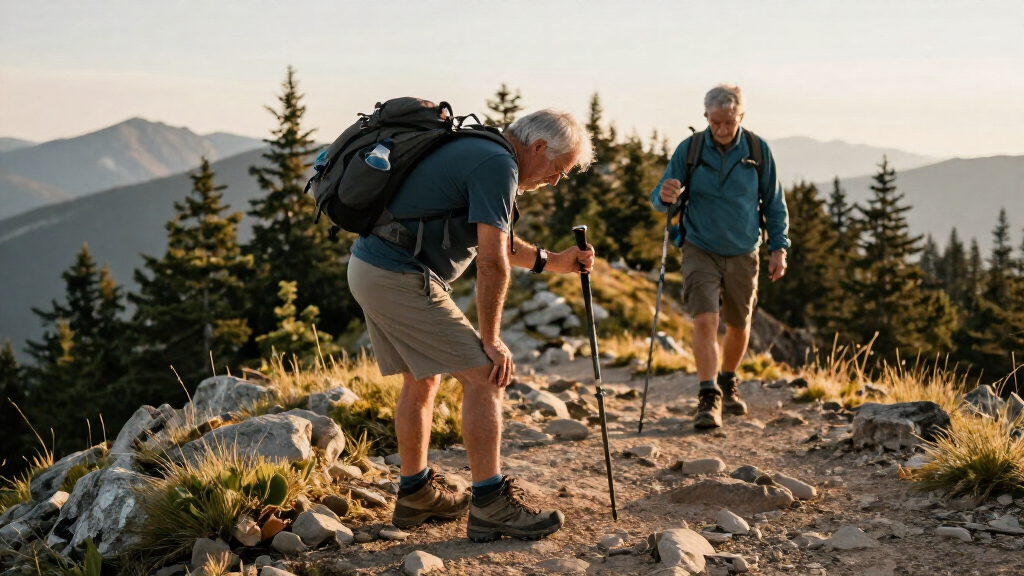
The writer says they live in London, where access to challenging terrain is limited, and make trips further afield a few times a year. On a recent visit to the Albanian Alps, they reached the summit and said they could move confidently over boulders and large rocks. They also reported having no knee niggles on the descent; that is their personal observation, not a clinical finding.
The writer identifies the step-up and Bulgarian split squat as exercises regularly included in a coach’s training plan and programmed for the writer’s personal-training clients. Both work one leg at a time and can be performed at home with a chair or at a gym. The report says they can be progressed from bodyweight to added resistance, allowing users to adjust the challenge.
For step-ups, the instructions call for placing one foot on a stable box or chair, pressing through that foot to rise, and lowering the other foot with control. The writer recommends 8–12 repetitions per side. A lower platform is offered as an easier option; a higher surface or a weight held at the chest makes the movement harder. The report particularly highlights controlled, slower step-ups as similar to the action of climbing uphill.
For the Bulgarian split squat, the rear foot rests on a knee-height bench, chair or couch while the front foot stays on the floor. The instructions say to bend the front knee to lower, keeping it above the ankle, then press through the front foot to stand. The suggested range is also 8–12 repetitions per side. Holding weights is presented as a way to increase difficulty. The source does not provide a training schedule or say how long someone should practise before a hike.
Training Strength for Uphill Walking
The report gives walkers two practical examples of single-leg strength exercises that require little equipment and can be adjusted in difficulty. Step-ups use a movement pattern resembling stepping onto higher ground, while split squats challenge the legs individually. That may make them useful options for people seeking to add strength work to preparation for hilly routes, particularly when steep outdoor paths are not nearby.
However, the account does not establish that these exercises prevent knee discomfort, reduce injury risk or guarantee an easier climb. The writer’s summit and reported lack of knee niggles are individual outcomes. Readers should treat the suggestions as exercise ideas, not a promise of a particular result; the report does not assess each reader’s fitness, mobility or health needs.
Popular right now

Roborock H60 Ultra-B Cordless Stick Vacuum Cleaner

Philips 2200 Series Fully Automatic Espresso Machine with Classic Milk Frother

Apple AirPods Pro 3 Wireless Earbuds with Active Noise Cancellation
As an affiliate, we earn on qualifying purchases.
A London Walker’s Alpine Preparation
The source is a first-person Fit&Well report, not a controlled study or a formal hiking-training guideline. Its central claim is grounded in the writer’s account: they regularly do single-leg exercises and felt steady during this particular hike. The article also says the writer works as a personal trainer and uses the movements with clients, but it supplies no client data or measured outcomes.
The described route reached 5,889 feet (1,795 metres) in the Albanian Alps. The report does not name the summit, give the route distance or elevation gain, or provide details about weather, pack weight or the writer’s wider preparation. Those factors can affect how demanding a hike feels, so the peak’s elevation alone does not describe the full challenge.
What the Personal Account Cannot Show
The report does not establish whether the exercises caused the writer’s steadiness or lack of knee discomfort. It gives no comparison with other training approaches, and no study data showing how the exercises affect hiking performance across a broader group. It also does not explain the writer’s full routine, how often they performed each movement, or how long they trained before the trip.
Details of the hike remain limited: the summit’s name, route conditions, distance and total ascent are not stated in the supplied report. Nor does the article specify how readers should choose a safe platform height or weight for their own circumstances. The source provides basic technique and progression suggestions, but not individualised coaching or medical guidance.
How Walkers Can Apply the Ideas
The Fit&Well report presents the movements as options for year-round strength training, with 8–12 repetitions per side as its suggested range. It advises beginning with bodyweight and a lower step for an easier version, then adding height or resistance to make the exercises harder. It does not set out a formal programme or say that readers should progress on a particular timetable.
Anyone considering the exercises can use the article’s instructions as a starting point, while matching the movement and load to their ability. The source does not address pain, existing injuries or medical conditions; people with concerns about exercise or a health condition can seek guidance from a qualified health professional or appropriately qualified trainer. No further study, follow-up or additional development is announced in the supplied material.
Key Questions
Which two exercises did the Fit&Well writer credit?
The writer named step-ups and Bulgarian split squats, saying they were regular parts of their training before hiking in the Albanian Alps.
How high was the summit?
The report gives the summit’s elevation as 5,889 feet (1,795 metres). It does not identify the summit by name in the supplied material.
How many repetitions does the report suggest?
It suggests 8–12 repetitions on each side for both movements. The article does not prescribe how many sets or training days to do.
Does the report prove these exercises prevent knee pain?
No. The writer says they had no knee niggles on this hike, but that is a personal account. The report does not provide evidence that the exercises prevent pain or produce the same result for other walkers.
Can the exercises be made easier or harder?
The report suggests using a lower platform for an easier step-up and adding height or weight to increase difficulty. For split squats, it suggests holding weights to make the movement harder. It does not provide personalised advice on selecting a load.
Source: fitandwell.com