
This checklist is for older adults managing daily medications, as well as family members and caregivers helping keep routines organized. The picks cover several ways to sort, remember, and handle medication; choose only the tools that fit the person’s routine and care plan.

Turn quiet afternoons into listening time
- Thousands of audiobooks, podcasts and originals
- Listen on your phone, tablet or Echo — also offline
- Cancel anytime
The sections follow the medication task: organizing doses, supporting reminders, and handling pills or bottles. Each includes practical points to check before choosing, since features and compatibility can affect whether a tool fits someone’s needs.
Use the list as a starting point, then confirm any medication-specific questions with a pharmacist or prescriber. In particular, check before splitting or crushing a pill, and make sure any dispenser or reminder routine matches the current prescription instructions.
Weekly pill organizer
A weekly organizer can make a medication routine easier to review at a glance, especially when doses need to be sorted ahead of time. The removable pouch system in this pick may suit someone who wants a way to keep the organizer and a carry option together. Before choosing, check how the compartments are divided and whether each one can hold the pills needed for that dose without crowding.
A common mistake is selecting an organizer based on its overall size without checking its openings. Small lids or compartments can be difficult for someone with limited dexterity, while loose-fitting closures may be inconvenient in a bag. Confirm that the organizer’s layout matches the person’s schedule, including any doses taken more than once a day. Also consider whether the person or caregiver can reliably refill and review it. A pill organizer supports a routine; it does not verify that the medication or dose is correct. Compare the layout with the written medication schedule, and ask a pharmacist whether pills with special storage instructions belong in an organizer.
What to look for:
- Compartment layout that matches the prescribed schedule
- Openings the user can manage comfortably
- Room for the pills needed in each dose
- Removable pouch details and carrying fit
- Closures that stay secure during ordinary handling
Waterproof Pill Organizer Set with Removable Pouch System

This waterproof travel pill organizer features a durable, leather-look exterior with a removable binder-style system containing 14 sealed pill pouches. It offers flexible storage for pills, vitamins, and small first-aid items, with color-coded labels and mesh pockets for easy organization and portability.
Pros:
- Waterproof and durable design keeps medications secure and discreet
- Removable binder system allows flexible organization for up to 14 days
- Color-coded labels and writable pouches enhance sorting and identification
- Includes mesh pockets for additional storage of small items
Cons:
- May be bulky for minimalists or those with limited space
- Relies on manual labeling, which may require extra effort
- Not suitable for large pill quantities or bulk medication storage
Best for: People who want weekly sorting with a removable pouch option.
Not ideal for: Anyone whose medication requires storage that is incompatible with an organizer.
Bottom line: Check the compartment layout and storage guidance before transferring pills.
Automatic pill dispenser
An automatic dispenser may help structure medication routines for someone who benefits from scheduled prompts or controlled access to doses. This pick’s name describes a 42-day capacity, app control, and expandable three-tray design, so check how those features work in practice before relying on them. Confirm whether the app and dispenser can be set up by the user or caregiver, and whether the person has a dependable way to hear or notice prompts.
A frequent buying mistake is assuming automation will resolve every medication-management challenge. The device still needs to be filled correctly, programmed to match the prescription, and checked when instructions change. Ask the pharmacist whether the medications can be loaded into this type of dispenser, and review what happens if a dose is missed, the device needs refilling, or the app cannot be accessed. Confirm that the tray arrangement and controls are manageable for the intended user. Carefully verify setup and refill steps with the person who will maintain the device; a dispenser should support, not replace, medication review and caregiver oversight where needed.
What to look for:
- Setup steps that the user or caregiver can follow
- Alerts the intended user can notice
- Tray arrangement suited to the medication routine
- Clear refill and missed-dose instructions
- App access and control requirements
42-Day Automatic Pill Dispenser with App Control, Expandable 3-Tray Design, LCD

This automatic pill dispenser has three trays with 14 dose slots each and supports remote scheduling and adherence monitoring through a companion app, or setup on the device with voice guidance. It offers LED, voice, buzzer, and melody alerts, plus a sealed lid with a desiccant pack and a digital lock.
Pros:
- Supports remote dose scheduling, monitoring, and plan adjustments through the app
- Offers on-device setup with voice prompts for users who do not use the app
- Multiple alert options help notify users when doses are due
- Sealed lid and desiccant pack help protect pills from moisture
Cons:
- Not suitable for assisted living facilities, nursing homes, or other regulated institutions
- The stated 42-day supply applies only to once-daily dosing
Best for: People with a caregiver who can help configure and refill it.
Not ideal for: Anyone who cannot reliably use or receive its app-based controls and alerts.
Bottom line: Confirm medication compatibility and the full setup routine before depending on automation.
Medication reminder clock
A talking reminder clock pairs time display with medication prompts, which may suit someone who wants reminders in a familiar, visible format. The ORKA pick is described as having a large display and customizable voice; check the actual controls and reminder setup to see whether they fit the user. Consider where the clock will sit, whether the display is easy to see from that spot, and whether spoken prompts can be heard in the usual setting.
One common mistake is treating a reminder as proof that a dose was taken. A clock can prompt, but the user still needs a way to confirm and record medication use if that matters to their routine. Check how many reminders can be set and whether the wording or sound can be adjusted to be clear and comfortable. Ask whether the controls are accessible to the person who will manage changes, and confirm any power or setup requirements in the product details. Match the reminder pattern to the prescription schedule, and revisit it whenever medication instructions change. If a caregiver helps, agree on how both people will know whether a dose was taken.
What to look for:
- Display readability from the planned location
- Voice prompts the user can hear and understand
- Reminder settings that match the medication schedule
- Controls that are manageable for setup and changes
- Clear instructions for power and routine maintenance
ORKA Talking Medication Reminder Clock with Large Display and Custom Voice Alarm
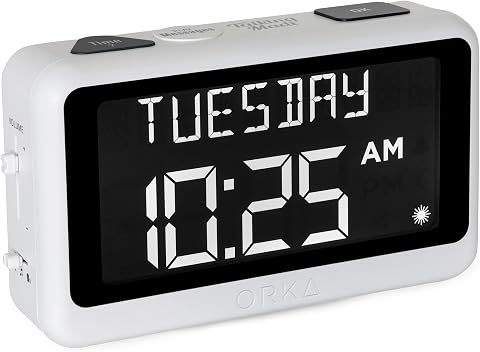
This AC-powered digital clock displays and announces the time, date, and day of the week, with large digits and spoken prompts in six languages. It supports up to eight recordable voice alarms, a 30-minute reminder loop, adjustable volume and brightness, and a backup battery to retain settings during power outages.
Pros:
- Large display and spoken time and date prompts support users with visual or memory impairments.
- Custom voice messages and up to eight alarms can provide personalized reminders.
- Offers six languages, adjustable volume, and a 30-minute reminder loop.
- Backup battery retains settings during a power outage.
Cons:
- Requires AC power for operation and is not battery powered.
- People with dementia may need help setting up the clock.
Best for: People who benefit from a large display and spoken reminders.
Not ideal for: Anyone who needs the reminder device itself to track whether a dose was taken.
Bottom line: Set prompts to the prescribed schedule and use a separate confirmation routine if needed.
Pill splitter
A pill splitter is useful only when a medication is approved to be divided and the prescriber or pharmacist has confirmed the intended dose. The EQUADOSE pick is described as having double stainless steel blades and centering, so review how a tablet is positioned and how the device is handled before choosing it. The user should be able to place the pill securely and operate the cutter without excessive strain.
A major mistake is splitting a tablet simply because it is large or difficult to swallow. Some medications should not be split, and a split may not provide the intended dose if a tablet is not designed for it. Confirm the specific medication with a pharmacist first, including whether it can be divided and whether the halves should be used in a particular way. Check the splitter’s opening and handling steps against the tablet shape and the user’s dexterity. Use it only with professional guidance, and keep the device clean according to its instructions so remnants from one medication are not carried into another. If the tablet crumbles or does not divide consistently, ask the pharmacist about alternatives.
What to look for:
- Pharmacist confirmation that the specific tablet may be split
- Opening size suited to the tablet shape
- Positioning steps the user can manage
- Blade handling and cleaning instructions
- A stable way to hold the device during use
EQUADOSE Pill Cutter with Double Stainless Steel Blades and Centering Device, Bl

This pill cutter is designed to split pills, tablets, and vitamins in a range of sizes, including small and tiny tablets. Twin stainless steel blades and an integrated centering device help align pills for even cuts.
Pros:
- Designed for pills in a range of sizes
- Dual blades help produce even halves
- Centering device helps align pills
- Stainless steel blades are designed for long-lasting performance
Cons:
- No dimensions or capacity details provided
- No user review content provided
Best for: People whose pharmacist has confirmed a tablet can be split.
Not ideal for: Anyone considering splitting medication without professional confirmation.
Bottom line: Confirm the medication is suitable before using any pill splitter.
Pill crusher
A pill crusher can help when a medication is approved to be crushed and the care plan calls for that form of administration. The Silent Knight Pill Crusher is the named pick here; check its operating steps and cleaning guidance to determine whether it fits the user’s needs. Consider who will operate it, whether they can apply the required motion, and how crushed medication will be handled afterward.
Do not assume a tablet can be crushed because swallowing it is difficult. Some medications must remain whole, and changing how a dose is taken can affect its use. Ask a pharmacist or prescriber about each specific medication before crushing it, and confirm what food or liquid, if any, is appropriate for taking the crushed dose. Check the crusher’s instructions for cleaning between medications and preventing leftover powder from mixing with another dose. Follow medication-specific advice every time, especially when the prescription list changes. If the user has trouble operating the device or handling the result, ask the care team about other options rather than improvising.
What to look for:
- Professional confirmation that each medication may be crushed
- Operating steps manageable for the person using it
- Cleaning guidance between medications
- Instructions for collecting and handling crushed medication
- A clear plan for taking the dose after crushing
Silent Knight Pill Crusher

The Silent Knight Pill Crusher features a silent handle that fits all hand sizes and a contour cover that encloses internal parts. It provides powerful dual-action crushing to turn pills into powder quickly with minimal effort.
Pros:
- Silent operation reduces noise during use
- Fits all hand sizes for comfortable grip
- Crushes pills quickly into powder
Cons:
- Limited information on durability
- No details on cleaning or maintenance
Best for: People whose care team has approved crushing a specific medication.
Not ideal for: Anyone without confirmation that the medication can be crushed.
Bottom line: Check each medication with a pharmacist before crushing it.
Prescription bottle opener
A bottle opener may be a practical aid for someone who has difficulty gripping or turning prescription containers. This pick is named an electric corkscrew bottle opener, so inspect its instructions and compatibility rather than assuming it works with every prescription bottle. Check which container closures it is designed to handle and whether the user can position and operate it comfortably.
A common mistake is overlooking the bottle’s safety cap or the user’s ability to manage the opener’s controls. Confirm that the device works with the actual containers in the household, including any child-resistant closures, and consider how the bottle will be held steady during opening. Review any charging or power requirements and how the tool is cleaned or stored. If the intended user cannot operate it safely, a pharmacist can discuss appropriate packaging options. Keep medication labels and closures legible, and make sure the opening method does not leave pills accessible to children or others who should not handle them.
What to look for:
- Compatibility with the prescription containers in use
- Controls the user can operate comfortably
- A stable way to hold the bottle during opening
- Clear power and maintenance instructions
- Safe storage that keeps medication secured
Electric Corkscrew Bottle Opener – Black

This electric corkscrew features a durable ABS handle and comes in a sleek black color. It is designed to effortlessly open wine bottles, making it a convenient addition to your kitchen or barware collection.
Pros:
- Easy to use electric operation
- Durable ABS handle
- Long-lasting 10-year warranty
- Sleek black design
Cons:
- Limited to wine bottle opening only
- Requires batteries or power source (not specified)
Best for: People who have difficulty gripping or turning bottle closures.
Not ideal for: Anyone whose prescription containers are incompatible with the opener.
Bottom line: Check the opener against the actual bottle closures before relying on it.
Build the routine around the highest-priority need first: confirm the medication schedule, then choose an organizer or reminder that fits it. Add a splitter, crusher, or bottle opener only when it addresses a specific handling need, and check medication changes with the pharmacist before adjusting the routine. Start with safe, accurate use and select tools the user or caregiver can maintain.
No device replaces clear instructions and regular review. Keep the medication list current, make sure the person knows how each tool fits into their routine, and ask the care team when something is difficult or unclear. With a setup that matches the person’s abilities and prescriptions, daily medication management can feel more manageable.