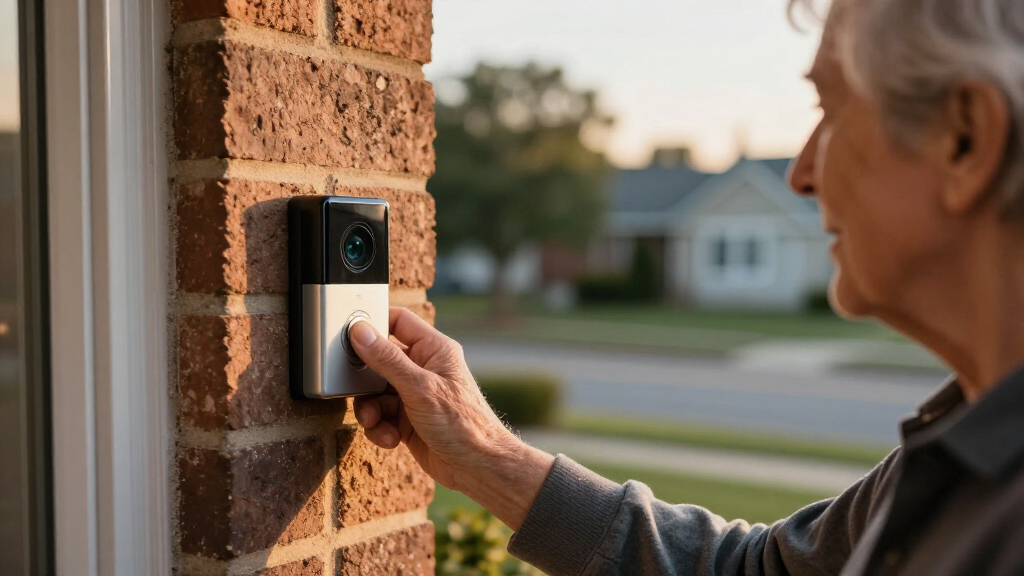

TL;DR
WiFi isn’t always reliable or private. Cellular-enabled and local-storage video doorbells let you monitor your home using mobile networks or local drives, offering independence from internet issues and cloud vulnerabilities.
Cellular-enabled doorbells let you monitor your home without relying on WiFi, ideal for rural or unreliable internet areas.
Local storage keeps your footage private and accessible even during internet outages, reducing ongoing costs.
Choosing the right power source—battery, solar, or wired—is key to maintaining continuous security.
A hybrid approach combining cellular backup with local storage offers maximum reliability and privacy.
Always check cellular coverage at your door location before purchasing a cellular doorbell to ensure optimal performance.
Video Doorbells Without WiFi
Cellular and local-storage alternatives keep watch when home internet fails—or when you simply prefer not to send every front-door interaction to a third-party cloud.
How a doorbell works without home WiFi
A cellular model behaves more like a smartphone than a conventional smart-home accessory. Its SIM connects directly to a nearby mobile network and carries events to the owner’s phone.
Motion or ring
The camera wakes when a visitor presses the button or enters its motion zone.
Video encoded
The device records a clip and compresses it for efficient transmission and storage.
SIM sends data
LTE or 5G carries the alert and video independently of the home internet connection.
Owner is notified
A mobile app provides the alert, live view and two-way response when supported.
Signal strength at the actual door matters. Test cellular coverage outside the entrance—not from a room deeper inside the property—before choosing a carrier or device.
Cellular versus local storage
The categories overlap: a cellular doorbell may also record to an SD card, while a local-storage model may temporarily use WiFi for remote access. The distinction is where each system places its primary dependency.
| Feature | Cellular doorbell | Local-storage doorbell | Decision signal |
|---|---|---|---|
| Connectivity | ✓Built-in SIM using LTE, 4G or 5G | May use wired LAN or WiFi for transfer, but recording remains local | Choose cellular where fixed internet is absent or unreliable |
| Recording | May transmit to a service, cloud destination or onboard card | ✓microSD, internal hub, drive or NAS | Choose local when ownership of footage is the priority |
| Outage behavior | Continues remotely if cellular service and power remain available | Continues recording locally if the device and storage remain powered | A hybrid system covers more failure scenarios |
| Ongoing cost | Cellular data plan and possible service fees | ✓Usually lower after hardware and storage setup | Calculate total cost over several years |
| Privacy | Strong independence from the ISP; provider handling still matters | ✓Very high when recordings remain offline | Encrypt storage and control physical access |
| Installation | Often simple, but requires SIM activation and coverage testing | Easy for battery models; wired hubs and NAS setups take more work | Complex wiring may justify professional installation |
Best all-round resilience: cellular backup + encrypted local recording + dependable power.
Why local storage changes the privacy equation
Local recording reduces dependence on external servers, subscriptions and internet uptime. It also shifts responsibility to the homeowner: capacity, backups and physical protection now matter more.
Simple and self-contained
An onboard card is inexpensive and easy to deploy. Use endurance-rated media, enable overwrite loops and check card health periodically.
Watch for removal or doorbell theftFootage away from the door
A protected indoor base station keeps recordings separate from the outdoor camera, reducing the risk that a stolen doorbell takes the evidence with it.
Good balance of ease and protectionCapacity and control
Network storage supports longer retention, backups and multi-camera systems. Setup is more technical, but ownership and policy control are strongest.
Confirm protocol and model compatibilityMatch the architecture to the risk
These relative scores visualize practical fit—not laboratory benchmarks. Actual performance varies with signal, device design, recording settings and power conditions.
Relative solution fit
Longer bars indicate a stronger match for the stated requirement.
Best for rural gates, detached buildings, temporary sites and homes with unreliable fixed broadband.
Best when privacy, footage ownership and predictable ongoing costs matter most.
Best for high-security entrances where both communication redundancy and offline evidence retention are important.
Connectivity is only half the uptime story
A doorbell cannot capture or transmit anything without power. Match the supply method to visitor traffic, climate, mounting position and maintenance tolerance.
Battery
Flexible and DIY-friendly. Frequent motion events, live viewing, cold weather and weak cellular signals may shorten time between charges.
Solar
Extends battery life with minimal intervention. Panel orientation, shade, seasonal daylight and regular cleaning determine real-world performance.
Wired
Provides the most consistent supply when compatible wiring is available. Installation may require a transformer check or professional support.
Build security as a connected system
The strongest installation does not depend on a single feature. Each link protects a different part of the path from visitor detection to usable evidence.
Test the carrier signal where the doorbell will be mounted.
Select battery, solar or wired continuity for the site.
Protect device access, accounts and stored recordings.
Set capacity, overwrite rules and backup intervals.
Keep footage accessible through outages and tampering.
Cellular backup + protected local storage
This hybrid approach preserves remote alerts when home internet fails while retaining a private local copy of important footage. It costs more to deploy, but removes more single points of failure.
- Confirm carrier bands and signal quality
- Compare plan limits and overage fees
- Verify SD, hub or NAS compatibility
- Estimate recording retention capacity
- Check wiring and solar exposure
Frequently asked questions
The right answer depends less on the word “smart” and more on three practical conditions: available signal, storage security and continuous power.
Will cellular work with no service at home?
Not effectively. Weak reception can cause delayed alerts, degraded video or complete loss of remote access. Test coverage first and consider another carrier, a suitable booster or a locally recording wired alternative.
Are there hidden cellular costs?
Plan for the device, SIM activation, monthly data service, data caps and possible overage charges. High-resolution clips and frequent live viewing consume more data than event-only alerts.
Is local storage more secure than cloud storage?
It reduces exposure to cloud account breaches and service failures, but physical protection becomes essential. Place hubs and drives securely, use encryption and maintain backups of critical footage.
Are solar models practical?
They can be highly practical with adequate sunlight and a healthy battery. Shade, winter conditions and dirty panels reduce output, so difficult locations may still need wired or battery backup.
Can I install one myself?
Battery-powered units are generally DIY-friendly. Wired, NAS-integrated and hybrid systems may need more technical setup. Professional help is sensible when transformer compatibility, mains wiring or complex networking is involved.
How Do Cellular Video Doorbells Work Without WiFi?
Cellular video doorbells use a built-in SIM card, connecting directly to LTE or 5G networks. Instead of relying on WiFi, they transmit video feeds and alerts through mobile data, much like your smartphone. This setup is particularly advantageous in areas where traditional internet connectivity is unreliable or nonexistent. By operating on cellular networks, these doorbells eliminate the dependency on your home’s internet infrastructure, which means they can function independently even during outages. However, this independence comes with tradeoffs: cellular plans incur ongoing costs, and signal strength can vary, affecting video quality and responsiveness. Choosing a device with good coverage and a reliable data plan is essential to ensure consistent performance. This approach provides peace of mind in remote locations, but it also requires careful planning around data usage and coverage to avoid unexpected costs or gaps in security.

aosu Doorbell Camera Wireless, Local Storage, 5MP Ultra HD, Triple Motion Detection, 2.4/5 GHz WiFi, Built-in 8GB, Rechargeable Battery, Alexa & Google Compatible
- Ultra HD Camera: 5MP resolution with optical glass lens
- Loop Recording: 60 days of local video storage
- Triple Motion Detection: PIR, radar, and AI for accurate alerts
As an affiliate, we earn on qualifying purchases.
As an affiliate, we earn on qualifying purchases.
Why Choose Local Storage Over Cloud for Your Doorbell?
Local storage means your footage stays on a microSD card, internal drive, or NAS device inside your home. Unlike cloud storage, which relies on internet connectivity and involves ongoing fees, local storage keeps your videos safely offline. This method enhances privacy because your data isn’t stored on external servers vulnerable to hacking or government surveillance. It also provides greater control—if your internet goes down or the cloud service experiences a breach, your footage remains accessible. However, local storage also introduces some considerations: physical security of the storage device is crucial, as theft or tampering can compromise your footage. Additionally, managing storage capacity is important; microSD cards or drives have limited space, requiring periodic maintenance or upgrades. The tradeoff is that local storage offers increased privacy and independence but demands proactive management and physical security measures. In environments where internet stability is uncertain or privacy is a top priority, local storage becomes especially advantageous, giving you direct control over your security footage without relying on third-party cloud providers.

BOIFUN Video Doorbell Camera Wireless – No Subscription Required, 2K HD
- Wide Field of View: 166° coverage for no blind spots
- High-Quality Aperture: f/2.5 for crisp details and soft background
- Reliable Wi-Fi: Supports 2.4GHz for strong signal
As an affiliate, we earn on qualifying purchases.
As an affiliate, we earn on qualifying purchases.
Compare Cellular and Local-Storage Video Doorbells Side by Side
| Feature | Cellular Doorbells | Local-Storage Doorbells |
|---|---|---|
| Connectivity | Uses SIM card, cellular network | Depends on wired connection or WiFi (for data transfer), but stores footage locally |
| Data Storage | Transmits footage over cellular; may store on cloud or SD card | Stores footage on SD card, internal drive, or NAS |
| Power | Battery or solar options | Battery, wired, or solar |
| Cost | Higher upfront + cellular plan fees | Lower ongoing costs but may need initial setup |
| Installation | Relatively straightforward; SIM activation needed | Varies; easy for battery models, more complex for wired |
| Privacy | High, depends on cellular provider | Very high; footage stays offline unless manually accessed |
Understanding these differences helps you choose a doorbell that aligns with your security priorities and environment. Cellular models offer mobility and independence from local internet infrastructure, ideal for remote locations or areas with unreliable WiFi. Conversely, local-storage models provide enhanced privacy and control, especially suitable for urban settings or where internet stability is questionable. Consider your specific needs—such as the importance of privacy, budget constraints, and installation complexity—to make an informed choice that enhances your home security effectively.

Ebitcam 4G LTE Cellular Security Camera Includes SIM Card(Support Verizon/AT&T/T-Mobile), 2K Solar Outdoor Cam Wireless Without WiFi Needed, 360° Live View, Color Night Vision
- Wireless 4G LTE Connectivity: Works without WiFi in U.S.
- Includes Prepaid SIM Card: Supports Verizon, AT&T, T-Mobile
- Unlimited Data Trial Included: 7-day free trial with activation
As an affiliate, we earn on qualifying purchases.
As an affiliate, we earn on qualifying purchases.
Frequently Asked Questions
Can a cellular video doorbell work if I have no cell service at my home?
Not effectively. Cellular doorbells depend on a strong cellular signal, so if your area has poor reception, their performance will suffer. In such cases, a local-storage doorbell with WiFi or wired connection might be better. This limitation underscores the importance of assessing your cellular coverage beforehand, as poor signal can lead to missed alerts and no video access. If coverage is weak, consider alternative options or signal boosters to enhance reliability.
Are there any hidden costs with cellular doorbells?
Yes. Besides the upfront cost of the device, you’ll need a compatible cellular plan, which can add monthly charges. Make sure to factor in data limits and costs when choosing a provider. Overlooking these costs might lead to unexpected bills or service interruptions, especially if your data plan has low caps or overage fees. Planning ahead ensures your security system remains operational without surprise expenses.
How secure is local storage compared to cloud storage?
Local storage keeps footage offline, making it less vulnerable to hacking or cloud breaches. However, physical security of the device and SD card or drive is essential to prevent tampering or theft. Unlike cloud storage, which offers remote access and redundancy, local storage requires you to secure the device physically. Proper placement and lockboxes can mitigate risks, ensuring your footage remains private and accessible only to you.
Do solar-powered options really last long enough to be practical?
Many solar-powered models now feature efficient panels and long-lasting batteries, often lasting several months without sunlight. Regular maintenance, like cleaning panels and checking battery health, can extend their lifespan significantly. While they are highly practical in sunny regions, in areas with less sunlight, supplementing with a wired power source or backup battery can ensure continuous operation.
Can I install a cellular doorbell myself?
Most battery-powered models are straightforward and DIY-friendly. Wired or hybrid models may require professional help, especially if wiring or cellular plan setup is involved. Proper installation not only ensures optimal performance but also maintains your home’s safety standards. When in doubt, consulting a professional can save time and prevent potential issues with wiring or connectivity.

anyfree Solar Video Doorbells Camera Wireless with Chime Pro (2nd), 2K HDR Wide-Angle, AI Smart Motion Detection, 2.4/5G WiFi, 2-Way Talk, No Subscription Local/Cloud, Night Vision, Works with Alexa
- Solar Powered with Built-in Battery: Long-lasting, no frequent charging
As an affiliate, we earn on qualifying purchases.
As an affiliate, we earn on qualifying purchases.