
TL;DR

Turn quiet afternoons into listening time
- Thousands of audiobooks, podcasts and originals
- Listen on your phone, tablet or Echo — also offline
- Cancel anytime
Yoga teacher Alina Boyett has shared a four-movement recovery flow for people who want gentle stretching after exercise or prolonged sitting. The sequence uses no equipment and is described as beginner-friendly, but its benefits are guidance from the instructor, not clinical findings.
Fit&Well has published a four-pose recovery yoga flow created by Alina Boyett, founder of UK-based Yogalina Studios, for people seeking gentle movement after exercise or a day spent sitting. The no-equipment sequence is presented as suitable for beginners, with Boyett advising participants to move slowly, avoid forcing stretches and stop rather than push through pain.
The routine includes waterfall pose, child’s pose, a ragdoll forward fold and a seated spinal twist. Boyett said she selected movements aimed at areas that can feel tense after activity, including the legs, hips, spine and shoulders. Yogalina teacher Misha Clarke demonstrates the sequence in a video accompanying Fit&Well’s report.
For waterfall pose, participants lie on their backs near a wall and raise their legs against it, keeping their knees slightly bent if that is more comfortable. The guide suggests one hold for three to five breaths. Child’s pose also calls for one hold of three to five breaths: start on hands and knees, lower the hips toward the heels, extend the arms and rest the forehead if it reaches the floor comfortably.
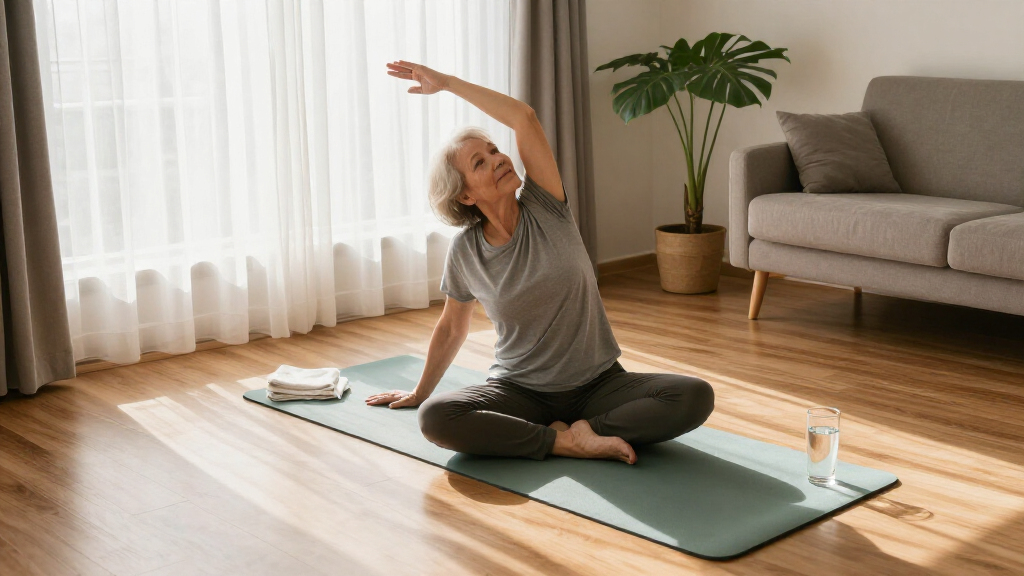
The standing ragdoll fold is listed for two rounds of three to five breaths. With feet hip-width apart and knees softened, participants fold from the hips and let the upper body hang; holding opposite elbows and swaying are optional. The final movement is a seated spinal twist, listed for two rounds of two to three breaths per side. Boyett’s instructions say to rotate gently and return to center before changing sides.
A Short Routine for Active Recovery
The report focuses on a practical distinction: recovery is part of an exercise routine, rather than simply a period of doing nothing. Boyett told Fit&Well that she encourages students to approach recovery with intention, alongside the effort they bring to workouts. The proposed sequence offers a short, equipment-free option for people who want to add gentle movement after a run, a challenging workout or prolonged desk work.
That may make the routine accessible to readers who are new to yoga or do not have time for a longer class. But the article does not provide clinical evidence that this particular sequence prevents injury, speeds recovery or produces a measurable increase in flexibility. Its benefits are framed as the instructor’s rationale and guidance. Readers should treat it as a set of optional movements, not a medical treatment or a substitute for individualized advice.
Popular right now

Vitamix Propel Series 750 Professional-Grade Blender, 4 Programs, Black

Breville Bambino Espresso Machine, Brushed Stainless Steel (BES450BSS)

Vitamix 5200 Professional-Grade Blender, 64 oz. Container, Black
As an affiliate, we earn on qualifying purchases.
Four Poses, No Equipment
Boyett described the flow as a combination of restorative postures, gentle twists and forward folds, intended to be done at home without specialist equipment or prior yoga experience. The instructions emphasize comfortable ranges of motion, rather than reaching a particular depth or matching another person’s flexibility.
The sequence moves between positions: lying with legs elevated, kneeling in child’s pose, standing in a forward fold and sitting for a twist. The supplied report recommends timed breathing rather than longer holds. It also warns that the movements should be adapted or skipped if they cause discomfort. That emphasis on choice is central to how the routine is presented: the goal is to slow down and notice how the body feels, not to push through a stretch.
Evidence and Individual Suitability
The source does not report a clinical trial or independent assessment of this four-pose routine. It is an instructor-created sequence, and claims about easing tension, helping relaxation or supporting mobility are attributed to Boyett. The report does not establish how much flexibility may change, how often the flow should be repeated, or whether it is appropriate for a particular injury or health condition.
Individual comfort and mobility vary, and the instructions do not cover every possible modification. Boyett advises anyone with an injury or relevant medical condition to seek appropriate professional guidance before trying the sequence. The source also does not specify a publication date, so the timing of the report cannot be narrowed further from the supplied material.
Use Comfort as the Guide
Fit&Well’s report presents the sequence as a self-paced routine rather than a plan with a required schedule or progression. Readers who choose to try it can follow the listed breath counts, make comfortable adjustments and leave out any movement that causes pain. Boyett’s guidance is to avoid forcing a stretch and to seek professional advice where an injury or medical condition is relevant.
No further testing, follow-up or update is identified in the source. The next step for readers is therefore practical rather than a reported news milestone: decide whether gentle movement is suitable for them, and treat the poses as optional stretching guidance rather than a promise of a particular recovery or flexibility outcome.
Key Questions
What movements are in Boyett’s yoga flow?
The sequence includes waterfall pose, child’s pose, a ragdoll forward fold and a seated spinal twist. The report gives breath counts for each movement and describes them as gentle options.
Does the routine require equipment or yoga experience?
Boyett describes the flow as requiring no equipment or previous yoga experience. Waterfall pose uses a wall, and the other movements are done on the floor or standing.
How long should each pose be held?
The guide lists three to five breaths for waterfall pose and child’s pose, and two rounds of three to five breaths for the forward fold. For the seated twist, it suggests two rounds of two to three breaths per side.
Is the flow proven to improve flexibility or speed recovery?
The supplied report does not cite clinical research testing this specific sequence or establish a measurable flexibility or recovery effect. The suggested benefits are Boyett’s guidance as a yoga teacher.
What should someone do if a pose hurts?
Boyett advises readers to move within a comfortable range and never force a stretch or push through pain. Anyone with an injury or relevant medical condition should seek appropriate professional guidance before trying the flow.
Source: rss