
TL;DR
Open a free Amazon Business account
Business pricing, bulk buying and tax-exempt orders.
Create a free accountAs an affiliate, we earn on qualifying purchases.
Straight stairlifts are simpler and quicker to install, suited for uninterrupted stairs. Curved models are custom-made for bends and landings but take longer and cost more. Proper assessment and planning are key for a safe, effective setup.
Imagine the frustration of struggling to climb stairs every day. Now, picture a sleek, motorized seat gliding smoothly along a rail, helping you reach the upper floor with ease. Choosing the right stairlift isn’t just about affordability — it’s about safety, comfort, and fitting your staircase perfectly.
This guide breaks down the differences between straight and curved stairlifts, what each involves in terms of installation, and how to make the best choice for your home. Whether you have a simple, straight staircase or one with twists and turns, understanding these basics will help you navigate the process confidently.
Straight stairlifts are quicker, cheaper, and ideal for stairs without bends.
Curved stairlifts are custom-built for complex stairs but cost more and take longer to install.
Proper assessment of your staircase and mobility needs is essential before choosing a system.
Installation involves precise measurements, support brackets, electrical hookups, and safety checks.
Regular maintenance and understanding safety features extend your stairlift’s lifespan and ensure safety.
Stairlift Basics: Straight vs Curved Tracks
The staircase decides the track. Straight systems bring speed and simplicity to uninterrupted flights. Curved systems follow bends and landings with a custom-made rail. The right assessment connects fit, comfort, timing, and safety.
One destination, two very different tracks
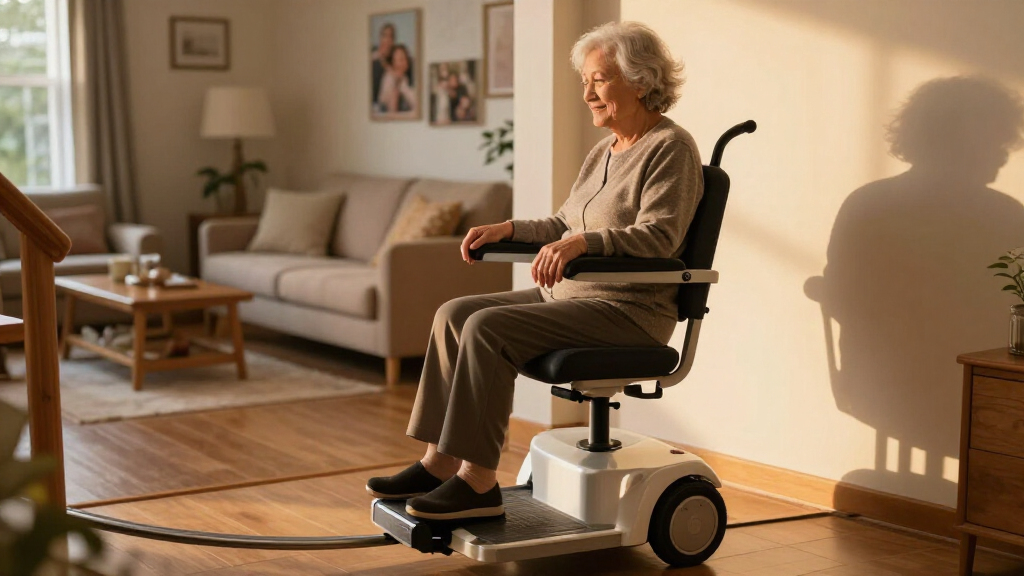
A stairlift is a motorized seat that travels along a rail. It suits a person who can transfer onto the seat; someone who must remain in a wheelchair generally needs a platform lift or home elevator.
Straight stairlift
Designed for a single uninterrupted flight without bends, intermediate landings, or changes in slope.
- Standard rail sections are cut to the required length.
- Usually costs less and can often be installed within a day.
- Rental and refurbished units are more widely available.
- A hinged rail can keep a doorway or hallway clear.
Curved stairlift
Built for the precise route of stairs with turns, winders, spirals, landings, or changing angles.
- Digital surveys, photographs, or templates capture the geometry.
- The custom rail provides a continuous ride through complex sections.
- Manufacturing increases both cost and delivery time.
- Resale value may be limited because the rail fits one staircase.
The geometry changes everything
The track choice influences timing, price, continuity, and future flexibility. A curved system should not be specified for a straight flight without a clear functional reason.
| Decision factor | Straight track | Curved track | Why it matters |
|---|---|---|---|
| Stair shape | ✓One uninterrupted flight | ✓Bends, winders, spirals, landings | The route determines which rail is feasible. |
| Rail production | ✓Standard sections cut to length | ~Manufactured to a detailed survey | Customization adds engineering and lead time. |
| Installation timing | ✓Often completed in a few hours | ~Installation follows weeks of preparation | Urgent mobility needs may favor a standard system. |
| Relative cost | ✓Lower | ✗Higher | Curved models can cost substantially more. |
| Rental or resale | ✓More practical | ✗Limited by bespoke rail | A reusable rail supports short-term or budget needs. |
| Ride through landing | ✗May require a second lift | ✓Continuous journey | Avoiding transfers can reduce fall risk. |
From assessment to a safe first ride
Installation is more than measuring rail length. The process must account for the user, the route, other people using the stairs, and safe access at both landings.
Assess
Review mobility, balance, strength, posture, transfers, joint limits, and likely future needs.
Measure
Check length, width, rise, headroom, landing space, bends, and knee or foot clearance.
Configure
Choose the safest side, parking point, seat type, footrest, rail end, and controls.
Fit
Secure support brackets to sound stair treads, install the rail, chair, and power system.
Verify
Test travel, swivel, braking, sensors, charging, clearances, and safe user operation.
Speed favors straight. Seamless travel favors curved.
These visual scales show relative planning intensity rather than fixed quotations. Actual timing and cost depend on the staircase, specification, region, and supplier.
A straight model may sometimes cost roughly half as much as a curved solution, but quotations must be compared on equivalent safety features and service coverage.
Two straight lifts or one curved lift?
Two straight units can reduce cost on flights divided by a landing. The compromise is a chair-to-chair transfer in the middle of the journey.
Potentially lower cost, independent installation, but requires a transfer.
Higher cost and longer lead time, but provides one continuous ride.
Poor balance, weakness, pain, or cognitive impairment can make landing transfers impractical or unsafe.
The best system fits the person and the place
A competent survey connects physical ability with staircase geometry. An occupational therapist can add valuable guidance when a condition is complex or likely to change.
Mobility and transfer
Balance, strength, pain, posture, cognition, height, weight, and the ability to sit and stand safely.
Space and clearance
Stair width, headroom, knee space, foot clearance, landing room, and access for other stair users.
Doors and fixtures
Doorways, radiators, handrails, narrow steps, loose treads, and anything affecting parking or travel.
Seat and operation
Manual or powered swivel, folding footrest, folding arms, remote call/send controls, or perch seating.
Clear circulation
A hinged or retracting rail can prevent the lower track from blocking a doorway or shared hallway.
Special requirements
Heavy-duty capacity, wider seating, outdoor weather resistance, or alternative boarding positions.
Bottom line: choose a straight stairlift for an uninterrupted flight and a curved stairlift when the route must follow bends or landings. Prioritize safe transfer, precise fit, professional installation, and regular maintenance.
Straight vs Curved Stairlifts: Which One Fits Your Stairs?
When you think about a stairlift, the first question is: what shape is your staircase? Straight stairlifts are designed for stairs that go straight up without any bends or landings. They use a simple, standardized rail that runs from bottom to top in a straight line.
In contrast, curved stairlifts are custom-made to follow the exact shape of your stairs. If your staircase twists, spirals, or has intermediate landings, a curved model is usually the only option.
Understanding these differences is crucial because choosing the wrong type can lead to additional costs or safety issues. For example, installing a straight lift on a curved staircase might require costly modifications or multiple lifts, which can be less safe and less seamless. Conversely, opting for a curved lift on a straight staircase unnecessarily increases expense and complexity. The core consideration is the staircase’s shape because it determines the feasibility, cost, and safety of the lift installation. Proper assessment ensures you select a solution that offers reliability, safety, and value, avoiding costly mistakes or compromises that could affect your daily safety and convenience.
As an affiliate, we earn on qualifying purchases.
Straight stairlifts: Quick, affordable, and ready to go
Imagine a staircase that’s a single, clean line. A straight stairlift fits perfectly here. These lifts are simpler, often using off-the-shelf rails that can be cut to fit your staircase length. Their straightforward design means they are generally less expensive — sometimes half the cost of curved models — and can be installed in just a few hours. This quick turnaround is particularly advantageous for those who need immediate mobility assistance or have budget constraints.
For example, if your staircase is 12 feet long with no turns, a straight lift can be up and running within a day, providing immediate safety and independence. This rapid installation minimizes disruption to your home life and allows you to regain mobility quickly.
Moreover, the availability of rental and refurbished options makes straight lifts accessible for short-term needs or budget-conscious consumers. However, it’s important to consider the limitations: if your stairs have obstructions, narrow widths, or a doorway at the bottom, you might need to plan for adjustments or consider other options. The key is that straight lifts excel in simplicity and speed but require careful assessment of your staircase’s layout to ensure compatibility and safety.
As an affiliate, we earn on qualifying purchases.
Curved stairlifts: Custom fit for complex stairs
A curved stairlift is a bespoke solution that offers a tailored approach to stairs with unique layouts. The rail is meticulously constructed to follow every bend, spiral, or landing in your staircase, ensuring a seamless and safe ride. This customization process involves detailed measurements—often using digital surveys, photographs, or physical templates—to craft a rail that precisely fits your home’s architecture.
The significance of this customization extends beyond aesthetics; it directly impacts safety and user comfort. A rail that doesn’t fit perfectly can cause discomfort, increase the risk of derailment, or lead to mechanical failures. For instance, a slight misalignment could make the lift unstable or cause it to derail, posing safety hazards. Investing in a precisely manufactured, custom-fit rail ensures stability and safety but also involves longer lead times—often several weeks—and higher costs.
For example, a homeowner with a winding staircase or a spiral design must opt for this bespoke solution. Although the process is more time-consuming and costly, the resulting ride is smooth, stable, and seamlessly integrated into the home’s architecture. This careful attention to detail guarantees safety, minimizes maintenance issues, and provides peace of mind for users with complex stairs.
As an affiliate, we earn on qualifying purchases.
Two straight lifts or one curved lift? Which is better?
If your staircase has a landing that splits the route, you might consider installing two straight lifts instead of one curved model. This approach can sometimes reduce overall costs and simplify the installation process because each lift can be installed independently on straight sections. However, this option introduces a significant tradeoff: the need for the user to transfer between lifts at the landing, which can be inconvenient or pose a safety concern for those with limited mobility.
For example, an elderly individual with balance issues might find the transfer process tiring or risky, increasing fall hazards. The inconvenience of multiple transfers can diminish the overall benefit of having a stairlift, especially for users with limited strength or flexibility. On the other hand, a continuous curved lift offers a single, seamless ride, eliminating transfer points and making mobility easier and safer for users with significant mobility challenges. But this seamless experience comes at a higher price and longer waiting period for installation.
Ultimately, choosing between these options requires weighing the importance of safety, convenience, and budget. If safety and ease of use are paramount, a curved lift might be the best solution despite higher costs. Conversely, if budget constraints are tight and users are capable of managing transfers, two straight lifts could be a practical alternative. Consulting with a mobility specialist allows you to evaluate these tradeoffs carefully and select the solution that best aligns with your safety needs, lifestyle, and financial situation.
As an affiliate, we earn on qualifying purchases.
Conclusion
Choosing between a straight and curved stairlift depends on your staircase’s shape and your mobility. Proper assessment and expert installation make all the difference in safety and comfort.
Remember, a well-fitted stairlift isn’t just a device — it’s a pathway back to independence and peace of mind. When in doubt, consult a professional and prioritize safety above all.
Labor Day sales Picks
labor day deals
As an affiliate, we earn on qualifying purchases.