TL;DR
Accurate home blood pressure readings depend on proper position, timing, and cuff fit. Following simple steps ensures your numbers reflect your true health, helping your doctor make better decisions.
Always sit with your back supported and your arm at heart level for accurate readings.
Take measurements at the same time each day to track true blood pressure trends.
Use a cuff that fits your arm correctly — measure your arm and choose the right size.
Avoid common errors like talking, crossing legs, or measuring over clothing.
Record your readings consistently over at least 7 days and share a detailed log with your doctor.
Home Monitoring Field Guide
Getting Consistent Blood Pressure Readings at Home: Position, Timing & Cuff Fit
A number that suddenly spikes or drops is frustrating — and dangerous if it leads to wrong conclusions. Tiny technique mistakes can skew a reading more than you think. The good news: technique matters as much as the device. Master three things — how you sit, when you measure, and how the cuff fits — and your numbers finally reflect your true health.
Key Insight
A misfitted cuff or poor positioning can shift readings by 10–20 mmHg — enough to change a hypertension diagnosis.
2× daily
Morning & evening, one minute apart
5 min
Quiet rest before the first reading
10–20 mmHg
Error from poor technique
2–8 mmHg
Systolic rise from crossed legs
75–100%
Arm the cuff bladder must cover
7 days
Minimum log for your doctor
135/85
Home average ≈ office 140/90
The Foundation
Three Pillars of a Trustworthy Reading
Getting blood pressure right is like setting a scale before weighing yourself — if the setup is off, the number is too. Every guideline from the AHA, ACC and ESH agrees: home readings only help when taken correctly.
Pillar 01 · Position
Sit Like It Matters
Back supported, feet flat, legs uncrossed, arm resting on a table so the cuff sits at heart level. An unsupported arm is like weighing on a wobbly table.
- Rest 5 minutes before the first reading
- Arm hanging down can inflate readings by ~10 mmHg
- First visit: measure both arms, then use the higher one
- No talking or phone use during measurement
Pillar 02 · Timing
Same Time, Every Day
Blood pressure follows a daily rhythm — dipping at night, surging in the morning. Random timing captures noise; consistent timing reveals trends.
- Morning: before medication and breakfast
- Evening: before bed — two readings, 1 min apart
- No caffeine, exercise or smoking within 30 minutes
- Don’t over-measure — anxious checking fuels spikes
Pillar 03 · Cuff Fit
Fit Like the Right Shoes
Too small and readings climb; too large and they fall. Measure your mid-arm circumference and match the cuff to your arm — most adults with obesity need a large cuff.
- Bladder should cover 75–100% of arm circumference
- Bare skin, 2–3 cm above the elbow crease
- Snug: exactly two fingers fit underneath
- Use a validated upper-arm device (validatebp.org)
The Error Budget
How Much Each Mistake Costs You
Each common error adds or subtracts real millimetres of mercury. Stacked together, they can misclassify you as hypertensive — or falsely reassure you. Approximate systolic shift, in mmHg:
The Daily Protocol
A Reading in Five Steps
Experts recommend measuring twice daily for 3–7 days before any clinical decision — and discarding day one, when anxiety and novelty inflate the numbers.
Prepare
Empty your bladder. No caffeine, exercise or smoking for 30 minutes.
Rest
Sit quietly for at least 5 minutes. No phone, no talking.
Position
Back supported, feet flat, legs uncrossed, cuff at heart level on bare skin.
Measure ×2
Take two readings, one minute apart. Record both.
Log It
Note time, readings, and context — caffeine, stress, activity.
135/85 mmHg
125/80 mmHg
Sizing Guide
Match the Cuff to Your Arm
Measure your arm’s circumference at the midpoint between shoulder and elbow. Many adults are mismeasured for years simply because they’re using a standard cuff on a larger arm — the classic cause of “cuff hypertension.”
| Cuff / Scenario | Mid-Arm Circumference | Bladder Coverage | Verdict |
|---|---|---|---|
| Small adult cuff | 18–22 cm | 75–100% | ✓ Correct fitRarely needed |
| Standard adult cuff | 22–32 cm | 75–100% | ✓ Correct fitDefault for most adults |
| Large cuff | 32–42 cm | 75–100% | ✓ Correct fitOften needed with obesity |
| Standard cuff on a 42 cm arm | 42 cm — mismatched | < 75% | ✗ Too smallReads falsely high — “cuff hypertension” |
| Oversized cuff on a slim arm | e.g. 24 cm — mismatched | > 100%, loose wrap | ~ Too largeMay read falsely low |
Placement
Cuff on bare skin, lower edge 2–3 cm above the elbow crease, tube aligned with the middle of the arm.
Snugness
You should fit exactly two fingers underneath the cuff — not more, not fewer.
Device
Choose a validated upper-arm monitor listed on validatebp.org or STRIDE BP.
Avoid
Wrist monitors are position-sensitive and second choice; finger devices are not recommended.
From Arm to Action
The Chain That Builds a Reliable Number
Each link depends on the one before it. Break any single link and the final average — the number your doctor acts on — stops reflecting your true blood pressure.
Measure Mid-Arm
Flexible tape, midpoint
Fit the Cuff
Bladder covers 75–100%
Sit Correctly
Arm at heart level
Time It Right
AM & PM, same hours
Log 7 Days
Two pairs per day
Share the Log
Averages + context
Know Your Numbers
The Thresholds That Matter
Home and office numbers are not interchangeable. The 2017 AHA/ACC guideline lowered the US hypertension threshold to ≥130/80 mmHg — making accurate home measurement essential for the millions newly classified.
≥130/80 mmHg
Office Threshold
The AHA/ACC 2017 hypertension cutoff. Accurate home readings determine whether you truly cross it.
≥135/85 mmHg
Home Average
A home average of 135/85 is treated as equivalent to an office 140/90 — a fact many readers miss.
15–20 mmHg
Inter-Arm Difference
A persistent gap between arms above this range warrants medical evaluation for vascular disease.
Common Questions
Frequently Asked Questions
The details that trip people up most often — answered with the same consistency-first logic.
Why does my reading vary so much day to day?
Position, time of day, stress, caffeine, and cuff placement all shift numbers. Consistent technique reduces this variability and reveals your true baseline.
Can I use a wrist monitor instead?
Acceptable if used carefully — the wrist must be at heart level — but they’re more position-sensitive and less reliable than validated upper-arm devices.
How often should I check at home?
Twice daily — morning and evening — for at least a week when first monitoring or adjusting treatment. Consistency beats frequency.
What if I forget to rest first?
Skipping the rest period can artificially raise your reading. Always sit quietly for at least 5 minutes before measuring.
How do I know my cuff size is correct?
Measure your mid-arm circumference and choose a cuff whose bladder covers 75–100% of it. Most cuffs ship with sizing guides — a 42 cm arm needs an extra-large cuff, not the standard one in the box.
Why Your Position Matters More Than You Think
Getting your blood pressure right is like setting a scale correctly before weighing yourself. If your position is off, your readings will be too. Sitting with your back supported, feet flat on the floor, and your arm at heart level creates a baseline that reflects your true pressure. Imagine trying to weigh a bag on a wobbly table — your readings are just as unstable if your posture isn’t right.
For example, crossing your legs can temporarily boost systolic pressure by 2–8 mmHg. Dangling your feet or leaning forward also adds noise. The key? Sit still, back straight, and support your arm on a table so the cuff sits at your heart’s level. This way, your blood pressure reflects your actual health, not your awkward sitting posture.
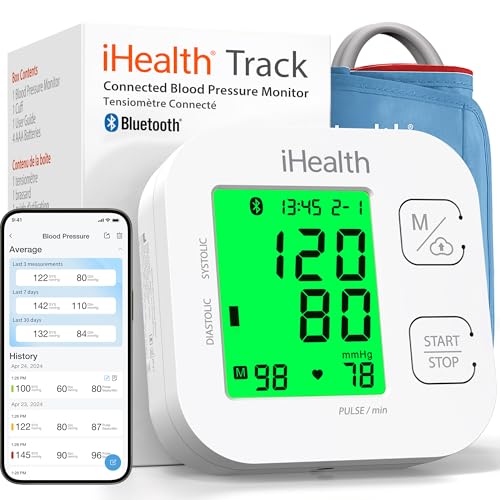
iHealth Track Smart Upper Arm Blood Pressure Monitor with Wide-Range Cuff
- Clinically Accurate: Easy operation, no calibration needed
- Large Multi-Color Display: Oversized numbers with color-coded readings
- Easy Data Management: Store up to 99 readings on device
As an affiliate, we earn on qualifying purchases.
As an affiliate, we earn on qualifying purchases.
Timing Is Everything: When and How Often to Measure
Taking your blood pressure at the same time every day isn’t just about routine — it’s about accuracy. Blood pressure follows a daily rhythm, dipping at night and rising in the morning. Measuring at inconsistent times introduces variability that can hide or exaggerate your real numbers.
Experts suggest twice daily — once in the morning before medication and breakfast, and once in the evening before bed. Two readings, one minute apart, give a clearer picture. For instance, a typical morning reading might be 135/85 mmHg, while your evening could be 125/80 mmHg. Tracking these patterns over a week helps your doctor understand your true blood pressure trends.
Understanding the timing is crucial because blood pressure naturally fluctuates throughout the day. If you measure randomly, you risk capturing numbers that are temporarily elevated due to stress, physical activity, or other factors, which can mislead your assessment. Consistent timing helps distinguish between transient spikes and genuine hypertension, enabling better management decisions.
iHealth Track Smart Upper Arm Blood Pressure Monitor with Wide-Range Cuff
- Clinically Accurate: Easy operation, no calibration needed
- Large Multi-Color Display: Oversized numbers with color-coded readings
- Easy Data Management: Store up to 99 readings on device
As an affiliate, we earn on qualifying purchases.
As an affiliate, we earn on qualifying purchases.
How to Ensure Your Cuff Fits Perfectly Every Time
Choosing the right cuff size is like picking the right shoes — fit matters. Too small, and your readings go up; too large, and they may go down. Measure your arm’s circumference at the midpoint — most adults need a large cuff, especially if they have obesity. Use a flexible tape measure for accuracy.
For example, if your arm measures 42 cm around, you need an extra-large cuff. The cuff’s bladder should cover 75–100% of your arm’s circumference. When applying it, snugness counts — you should fit two fingers underneath the cuff, not more. Using a validated device and correct placement (bare skin, 2–3 cm above the elbow) guarantees reliable readings.
Proper cuff fit isn’t just about comfort; it directly impacts the accuracy of your readings. An ill-fitting cuff can either inflate your numbers falsely or underestimate them, potentially leading to misdiagnosis or missed treatment opportunities. Regularly checking your cuff size and ensuring correct placement helps you trust your readings and provides your healthcare provider with dependable data.
iHealth Track Smart Upper Arm Blood Pressure Monitor with Wide-Range Cuff
- Clinically Accurate: Easy operation, no calibration needed
- Large Multi-Color Display: Oversized numbers with color-coded readings
- Easy Data Management: Store up to 99 readings on device
As an affiliate, we earn on qualifying purchases.
As an affiliate, we earn on qualifying purchases.
Common Mistakes That Skew Your Blood Pressure Readings
Many people unknowingly introduce errors that throw off their numbers. Crossing your legs, talking, or measuring over clothing can all add or subtract a few mmHg. A full bladder can raise your reading by 10+ mmHg. Using an ill-fitting cuff or unsupported arm can make your numbers wildly inaccurate.
Imagine measuring your blood pressure after a cup of coffee — it might be higher by 5–10 mmHg. Or measuring in a noisy, stressful environment — your anxiety can add to the reading. The best approach? Sit quietly, support your arm, and avoid these common pitfalls for a true snapshot of your health.
Understanding these mistakes is vital because each one can lead to misinterpretation of your health status. For example, measuring over clothing might seem convenient but can insulate the cuff, leading to falsely low readings. Similarly, measuring with a full bladder can temporarily elevate your numbers, potentially prompting unnecessary concern or medication adjustments. Recognizing and avoiding these pitfalls ensures each reading accurately reflects your current blood pressure and helps prevent unnecessary anxiety or treatment errors.
iHealth Track Smart Upper Arm Blood Pressure Monitor with Wide-Range Cuff
- Clinically Accurate: Easy operation, no calibration needed
- Large Multi-Color Display: Oversized numbers with color-coded readings
- Easy Data Management: Store up to 99 readings on device
As an affiliate, we earn on qualifying purchases.
As an affiliate, we earn on qualifying purchases.
How to Share Your Readings with Your Doctor for Better Care
Consistent blood pressure measurements are most helpful when you bring a clear, organized log to your healthcare provider. Aim for at least 7 days of readings, recorded twice daily — morning and evening. Calculate the average, and note any patterns or unusual spikes.
For example, if your average over a week is 138/86 mmHg, your doctor might consider lifestyle adjustments or medication. Use a dedicated notebook or digital app, and include notes about your activities, caffeine intake, or stress levels. This way, your doctor gets a complete picture, not just scattered numbers.
Sharing detailed, accurate logs allows your healthcare provider to see trends over time rather than isolated readings. This comprehensive view helps in diagnosing hypertension accurately, tailoring treatment plans, and making informed decisions. It also minimizes the risk of overreacting to temporary fluctuations and ensures that your management strategy is based on reliable data, ultimately leading to better health outcomes.