
TL;DR

Turn quiet afternoons into listening time
- Thousands of audiobooks, podcasts and originals
- Listen on your phone, tablet or Echo — also offline
- Cancel anytime
Physical therapist Devin Trachman recommends the sit-to-stand exercise as a practical way to build strength used in walking and other daily activities. Her suggested routine is two to three sets of eight to 10 repetitions, with chair support available for people who need it.
Physical therapist Devin Trachman recommends the sit-to-stand exercise as one way to build lower-body strength used in walking and everyday movement, according to a Fit&Well report. She suggests two to three sets of eight to 10 repetitions, with a sturdy chair and modifications for people who need support.
Trachman, identified by Fit&Well as clinical director of Physical Therapy Central in West Edmond, said standing up from a chair rehearses a movement people use regularly. The exercise works the quadriceps and gluteus maximus, along with core stabilizers, according to the report. Those muscles contribute to tasks such as walking, climbing stairs and rising from a seated position.
To perform the movement, sit near the front of a sturdy chair with feet flat and about shoulder-width apart. Lean the chest slightly forward while keeping the back straight, then push through the heels to stand upright. Lower back to the seat slowly and with control. Fit&Well lists 60 seconds of rest between sets and advises avoiding hand support if possible.
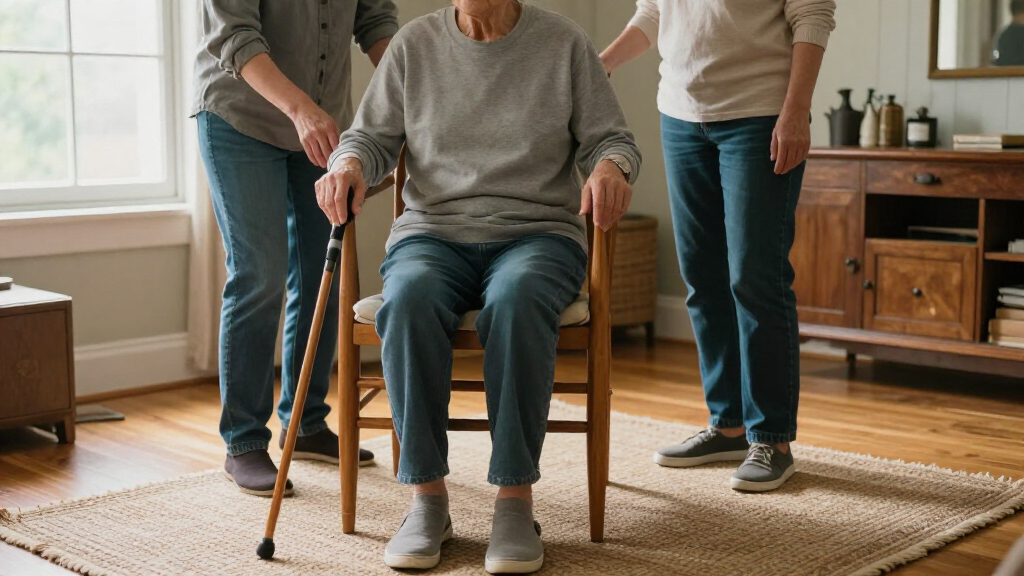
People who cannot yet stand without using their arms can choose a chair with armrests and use them for light support while building strength. The report also suggests a sturdy support in front of the person. Trachman’s recommendation is a general exercise suggestion, not an individualized assessment or treatment plan.
Strength for Everyday Walking
The recommendation addresses a practical concern: walking can feel harder when strength, balance or endurance declines, and reduced activity can make those difficulties more pronounced. Trachman told Fit&Well that this pattern may be reversed through gentle strength training. Her reasoning is that building capacity for standing and other daily movements may make walking feel more manageable for some people.
The exercise is relevant because it uses a familiar action rather than specialized equipment. A controlled chair rise can also connect strength work to tasks people may want to maintain, including getting up independently and using stairs. But the report does not provide trial results or evidence that sit-to-stands alone improve walking for everyone. The recommendation should be understood as one physical therapist’s practical starting point, not a guaranteed outcome.
Popular right now

Bose QuietComfort Ultra Wireless Noise-Cancelling Headphones with Spatial Audio, Black

TCL QM64L 85-Inch QD-Mini LED 4K Smart Fire TV

TCL T7 Series 85-Inch 4K 144Hz QLED Smart Google TV
As an affiliate, we earn on qualifying purchases.
Why Chair Rises Relate to Mobility
Trachman told Fit&Well that people may walk less not simply because they have grown older, but because daily life becomes busy, pain develops or walking feels more tiring. She said lower activity can be followed by weaker supporting muscles, reduced balance and lower endurance, which may make walking feel harder still.
Her advice is to build strength and confidence rather than relying only on an instruction to walk more. The report frames sit-to-stands as a functional lower-body exercise, but it does not compare the movement with other exercises or establish that it is the best option for every person. Trachman is a physical therapist with a Doctor of Physical Therapy degree and an orthopaedic clinical specialist certification, according to the report.
““If I could only prescribe one exercise to improve walking, this would be it.””
— Devin Trachman, physical therapist, as quoted by Fit&Well
Limits of the Exercise Advice
The source report does not cite a clinical study comparing sit-to-stands with other exercises, nor does it provide evidence that the routine improves walking outcomes across a broad group. It also does not specify how long a person should follow the suggested sets and repetitions before expecting a change. Trachman’s statement is an expert recommendation, not a reported finding from a new study.
The report does not address which adaptations may be appropriate for people with particular injuries, pain, balance problems or health conditions. Readers should not assume that a movement is suitable for them solely because it is described as accessible. Anyone unsure about exercising safely can ask a qualified health professional, such as a physical therapist, for guidance suited to their abilities.
How Readers Can Apply the Guidance
Fit&Well’s report gives a starting routine rather than announcing a formal program or follow-up study: two to three sets of eight to 10 sit-to-stands, with about 60 seconds of rest. It recommends controlled movement and light hand support when needed. No further research, clinical trial or update was announced in the supplied material.
The next step for readers depends on their own mobility and comfort. Those who try the exercise can follow the described form and use a stable chair; people who experience pain, feel unsteady or have concerns about whether it is appropriate can consult a qualified professional before continuing. The report offers no promised timeline for changes in walking or independence.
Key Questions
Which exercise did Devin Trachman recommend?
She recommended sit-to-stands: rising from a sturdy chair and lowering back down with control.
How many sit-to-stands does the report suggest?
Fit&Well lists two to three sets of eight to 10 repetitions, with about 60 seconds of rest between sets.
Can someone use their hands for support?
Yes. The report suggests using a chair with armrests for light support if standing without the hands is not manageable yet. It also mentions a sturdy support in front.
Does the report prove sit-to-stands improve walking for everyone?
No. It reports one physical therapist’s recommendation and does not present a study showing that the exercise improves walking for everyone or is superior to other options.
Source: rss