TL;DR

Turn quiet afternoons into listening time
- Thousands of audiobooks, podcasts and originals
- Listen on your phone, tablet or Echo — also offline
- Cancel anytime
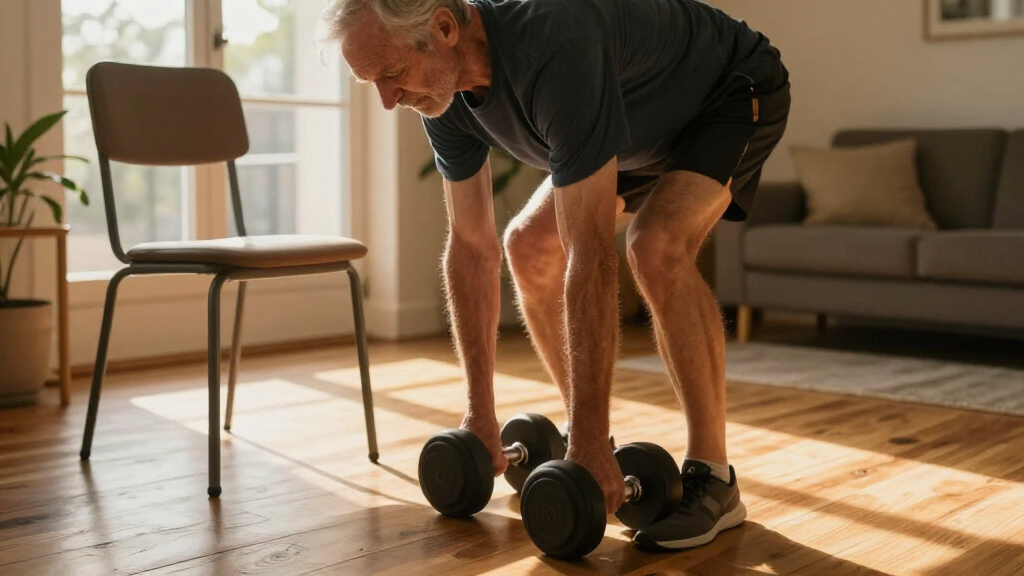
A Fit&Well contributor says he introduced his 73-year-old father to a short dumbbell routine after the older man had fallen away from strength training while caring for his wife. The plan uses goblet squats, single-arm rows and overhead presses; it is a personal account, not evidence that the routine suits every older adult.
A Fit&Well contributor says he helped his 73-year-old father return to strength training with a three-exercise dumbbell routine: goblet squats, single-arm rows and overhead presses. The contributor described the plan as a way to work on full-body strength and mobility while accounting for his father’s limited time as a caregiver.
The contributor wrote that his father had been active but had recently neglected strength work while caring for his wife, who has Parkinson’s. He said he supplied light-to-medium dumbbells and reviewed basic lifting form, including holding a weight close to the body, bracing the core and keeping an upright position. The account does not give the weights used or report measured results.
Before adding dumbbells, the pair spent a few weeks practicing bodyweight movements, including squats, hip hinges, lunges and pushing patterns, according to the report. The routine then focused on three movements, each prescribed for three sets of 8–12 repetitions. The source presents this as one trainer’s plan for his father, rather than a tested program or a universal recommendation.
The goblet squat holds one dumbbell at the chest and works the legs and hips through a squat pattern. The single-arm row is performed with one hand supported on a sturdy surface while the other pulls a dumbbell toward the ribs. For the overhead press, dumbbells start at shoulder height and are pushed overhead with the torso upright. The article suggests easier alternatives, including chair-supported sit-to-stands, a kneeling row and a seated press.
How the Moves Relate to Daily Tasks
The routine is framed around actions people use outside a workout: standing from a chair, picking up bags and reaching overhead. The contributor says the three exercises were chosen to train those patterns with resistance, rather than to pursue a sport-specific goal. That makes the account relevant to readers looking for a concise example of how strength exercises can be organized around everyday movements.
It also highlights a practical constraint: the father had limited time because of caregiving responsibilities. A three-exercise plan may be easier to fit into a schedule than a longer routine, but the report does not establish how often he trained, whether he completed all prescribed sets, or whether the program improved his strength. Its claims about benefits are the contributor’s rationale, not reported outcomes from an assessment.
Popular right now

Ninja CREAMi 7-in-1 Ice Cream Maker, NC299AMZ

De'Longhi Rivelia Automatic Espresso Machine with Milk Frother

Samsung 85-Inch QN70H Neo QLED 4K Smart TV (2026)
As an affiliate, we earn on qualifying purchases.
Preparation Before Adding Weights
The article describes a progression rather than beginning with loaded exercises immediately. The father and contributor practiced bodyweight versions of basic movements for a few weeks, with attention to technique. The contributor then introduced light-to-medium dumbbells and reviewed posture and core engagement. Those details matter because the routine was tailored to one person after a period of preparation; the source does not say the same starting point is appropriate for every 73-year-old.
Each exercise includes a lower-demand option. A person who is not ready for a weighted squat could use a bodyweight squat or sit-to-stand from a chair. The row can be done on one knee for added stability, while a seated overhead press with back support is offered as an alternative. The report also describes a harder variation for the press, but does not provide guidance for selecting a safe weight or progressing the load.
Results and Individual Suitability
The report does not say how long the father followed the dumbbell plan, how often he performed it, what weights he used, or whether his strength or mobility changed. It also provides no independent evaluation or comparison with another program. The article’s description is a personal account, not clinical evidence that the routine prevents injury, improves balance or produces a particular health outcome.
There is no information about the father’s medical history, joint limitations or advice from a health professional. The source offers easier exercise variations but does not set out screening criteria or guidance for people with pain, balance problems or other health concerns. Individual ability and the need for supervision are not addressed.
Adapting the Routine Safely
The Fit&Well report does not announce a follow-up or provide a progression schedule. It leaves readers with the described exercises and modifications, but does not specify training days, rest periods or how to increase weight over time. Those details would be needed to reproduce the father’s full training plan.
For readers considering similar movements, the account supports a cautious distinction between an example and individualized guidance: it describes starting with bodyweight practice and offering supported alternatives, but does not assess a reader’s needs. Anyone with health concerns or uncertainty about technique can seek guidance from a qualified fitness or health professional before beginning or changing an exercise routine.
Key Questions
Which three exercises are in the routine?
The plan uses a dumbbell goblet squat, a single-arm dumbbell row and a dumbbell overhead press.
How many sets and repetitions does the report suggest?
It lists three sets of 8–12 repetitions for each movement. The report does not specify how many days per week the father performed the routine.
What easier versions does the article describe?
Options include bodyweight squats or chair sit-to-stands, a kneeling one-arm row, and a seated overhead press using a chair with back support. These are alternatives in the report, not a personal assessment of what an individual should do.
Does the report show that the routine improved the father’s strength?
No measured results are provided. The contributor describes the routine’s intended purpose but does not report strength tests, mobility changes or other outcomes.
Source: rss